
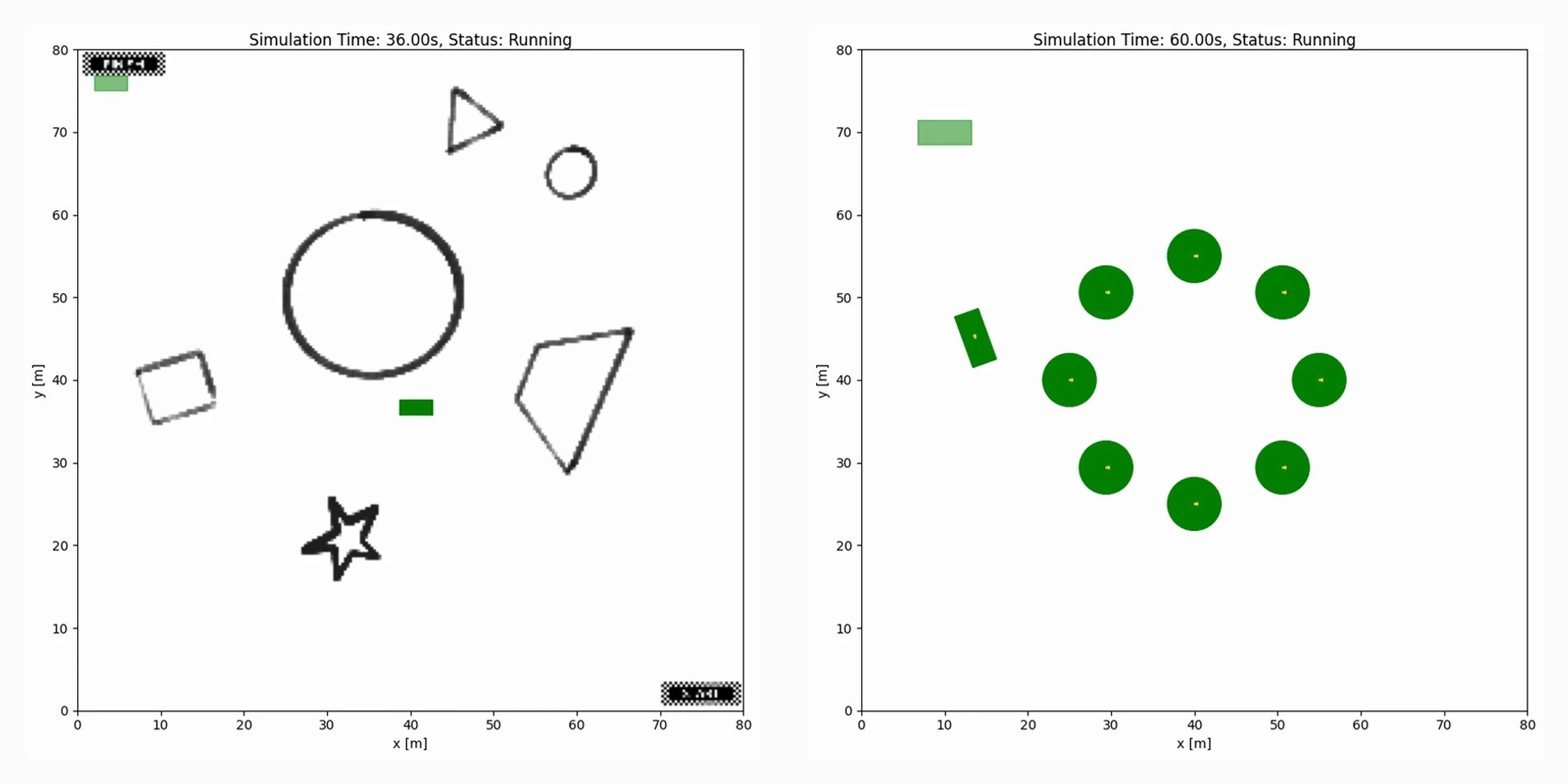
Autonomous Navigation in IR-sim
DEGREE OBJECTIVE 6
Implement artificial intelligence and data systems into robotic platforms.
How it meets the objective: It implements two AI navigation methods on a configurable robotic platform and evaluates them with recorded pass/fail evidence across five scenarios — failures analyzed, not hidden.
RVO in its designed use case: multiple moving agents, all avoiding each other in real time — Test 3, pass.
Custom robot kinematics, custom maps, and a documented pass/fail evaluation of two autonomy behaviors — goal-seeking Dash and Reciprocal Velocity Obstacles (RVO) — built in RBT347 with Python, IR-sim, and YAML robot and world configuration.
What I tested
I built custom 500x500 maps and configured robots with both Ackermann (car-like) and differential kinematics, then ran Dash and RVO through the scenarios below. The pass/fail pattern maps directly to the standard navigation architecture: a global planner for static geometry layered with a local avoider for dynamic agents. Neither alone is sufficient — RVO needs lateral velocity freedom, so it performs with differential kinematics rather than Ackermann constraints, and Dash has no avoidance or replanning at all.
| Test | Scenario | Result | Video |
|---|---|---|---|
| 1 | RVO vs. drawn static shapes | Fail — collision | Watch |
| 2 | RVO vs. large static circle | Fail — deadlock | Watch |
| 3 | Multiple moving RVO agents | Pass — mutual avoidance | Watch |
| 4 | Static agents in circle formation | Pass — routed to goal | Watch |
| — | Dash goal-seek, wall in path | Fail — no avoidance | Watch |
| — | Keyboard teleop, Ackermann | Baseline | Watch |
| — | Manual drive, custom map | Baseline | Watch |
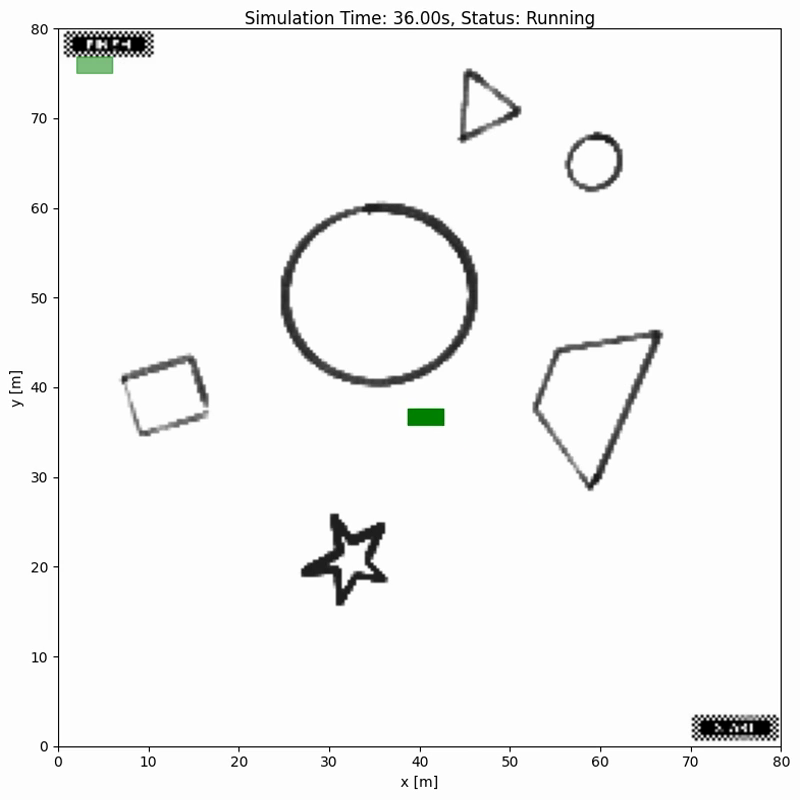
Test 1 end state — RVO pressed into the drawn-shape geometry with no global planner to reason around it.
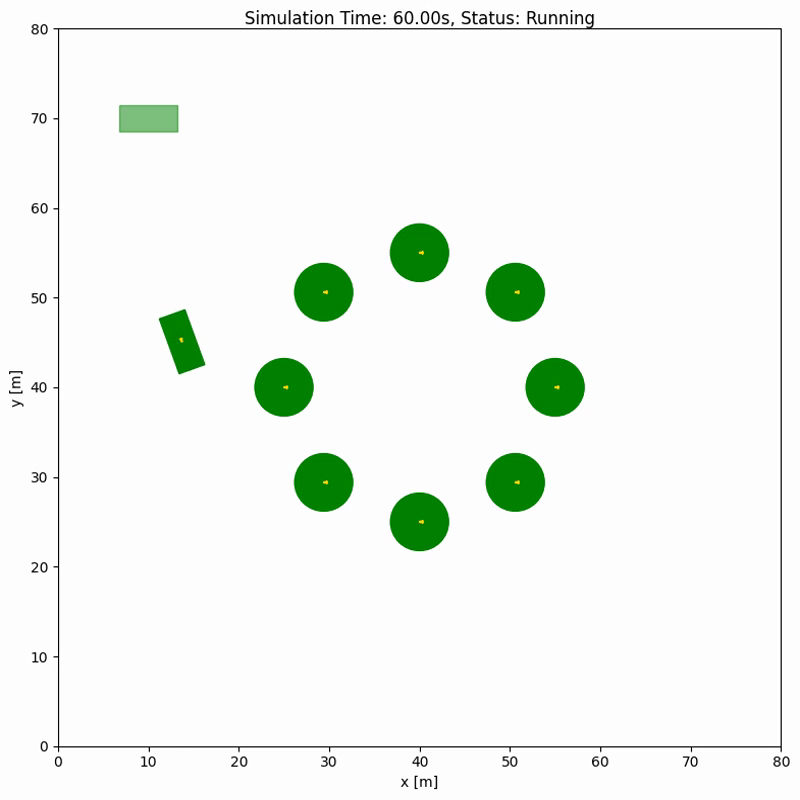
Test 4 — the robot is routing around the circular formation of static agents to reach its goal.