
Innovation Brief
The research, prior art, and engineering criteria behind a rail-mounted robotic tunnel inspection concept.
The technical foundation behind the Subway Sentinel concept.
This Innovation Brief documents the problem addressed, the selected system architecture, relevant prior art, the systems-level innovation claim, and the criteria used to evaluate the completed digital prototype. It defines what the project is, why it matters, how it was evaluated, and where its limits remain.
The project spans industrial six-axis robotics and automation, rail-based mechanical systems, non-destructive evaluation, and safety-focused systems engineering, with ground-penetrating radar as the initial inspection payload.
July 18: Platform FEA Rev B closed. July 19: The measured deck closed the anti-tip screening and the final payload/inertia record was completed. July 23: Motion Cycle 2 completed with zero logged collision, singularity, or joint-limit events, and the Criteria A–E matrix reached 23 of 23 verified items. July 30: The final project showcase video was completed and submitted.
Fusion 360 supports CAD, mass properties, and screening-level structural analysis. ABB RobotStudio supports payload entry, reach and joint review, collision checks, inspection-path development, and the final simulated motion evidence.
Industrial manipulation
Repeatable six-axis motion, payload definition, reach studies, and controlled sensor positioning.
Rail mechanical systems
A welded platform, pivoting bogie interfaces, deck, and robot foundation sized around a subway reference envelope at standard gauge, 1,435 mm.
Non-destructive evaluation
Robotic GPR positioning for track-bed and tunnel-interface scanning, with future multi-sensor expansion.
Systems engineering
Load cases, structural screening, stability checks, collision review, and clearly documented assumptions.
A project shaped by New York, underground work, and practical robotics experience.
Subway Sentinel emerged from a lifelong connection to New York City, its subway system, and the workforce that built and maintains it. Daily reliance on the subway made its importance unmistakable, while recurring delays and service disruptions highlighted the challenges created by aging tunnel infrastructure. The idea was also shaped by close, long-term exposure to the work of a family member who was a sandhog, providing a firsthand window into tunnel construction and the realities of underground work.
Sandhogs are highly specialized tunnel-construction workers who build and rehabilitate the structures beneath New York. Track inspectors and maintenance-of-way crews perform the separate job of evaluating and maintaining tunnels in active service. Both workforces operate in confined underground environments affected by water intrusion, difficult access, and infrastructure hazards. Those realities motivate inspection tools that can reduce repetitive exposure while supporting—not replacing—the judgment of experienced crews and engineers.
Combined with my professional background in industrial robotics and my interest in applying six-axis systems to meaningful field problems, these experiences led to a rail-mounted robotic inspection concept focused on repeatable sensor positioning and transparent engineering validation.
Prior art shows that the ingredients exist. The design question is how they are integrated.
The review covers truck systems, hyrail platforms, tunnel robots, rail inspection vehicles, robotic maintenance systems, and GPR-specific concepts. Several references are close to Subway Sentinel in function. The defensible innovation claim is therefore systems integration and adaptation—not invention of robotic tunnel inspection, GPR, or rail mobility.
No single reference reviewed combines the project’s complete architecture: an NYC subway reference model with a documented width deviation, a full-size industrial robot, continuous-motion operating constraints, a modeled Stream T payload, a standardized robotic tool interface, tool-stand handling, and a documented structural/stability/motion validation chain.
Sonic Meister / 8-ton Truck Impact-Sound System
Description: An eight-ton truck carries a general-purpose arm robot, lift, positioning instruments, and a five-hammer impact unit for concrete-lining diagnosis. The system mechanizes impact-sound inspection and can identify indications of exfoliation and cavities.
Difference: It is a road-vehicle and lift-based impact system operated by a crew. Subway Sentinel uses a rail-aligned platform, a GPR payload, and a continuous-motion robotic inspection concept.
IRIS Hyrail System
Description: Penetradar’s IRIS Hyrail configuration places GPR equipment on a telescopic assembly attached to a road/rail-capable vehicle for rail and tunnel inspection.
Difference: Subway Sentinel uses a six-axis industrial robot for articulated sensor positioning, repeatable path development, and a modular tool interface.
ROBO-SPECT
Description: An autonomous tunnel-inspection system combining a mobile vehicle, lifting structure, robotic arm, computer vision, laser profiling, and ultrasonic sensing for tunnel-lining assessment.
Difference: Subway Sentinel uses a rail platform and a GPR-first EOAT concept instead of the lift-and-arm architecture used for close-range surface defect measurement.
JR Central Tunnel Inspection Robot
Description: JR Central developed a robotic system to improve and standardize tunnel-lining inspection, including automated impact-sound work that otherwise places a high physical and skill burden on inspectors.
Difference: Subway Sentinel is a subway-oriented digital design study centered on rail-platform integration, robotic GPR positioning, and subsurface inspection rather than automated hammer testing alone.
Baubot with KUKA KR IONTEC
Description: A mobile construction robot built around a KUKA industrial arm for repetitive tasks such as drilling and installation in demanding construction environments, including tunnel work.
Difference: Subway Sentinel applies industrial robotic manipulation to rail-mounted inspection and GPR positioning rather than construction automation.
MTI-200a Metro Tunnel Inspection System
Description: A metro tunnel surface-inspection vehicle using six line-scan cameras, controlled lighting, and deep-learning image recognition for crack and leakage detection. The reported platform operates at up to 10 km/h with 0.2 mm/pixel imagery.
Difference: MTI-200a is a fixed visual-imaging system. Subway Sentinel uses an articulated GPR payload to explore subsurface and hidden-condition inspection.
Rapid Air-Coupled GPR Tunnel Inspection Vehicle
Description: A rapid GPR tunnel-inspection platform combining mobile laser scanning, AprilTag references, and GPR for localization and obstacle avoidance. The paper reports testing at up to 9 km/h.
Difference: Subway Sentinel focuses on six-axis tool positioning and a modular EOAT architecture instead of relying on fixed or dedicated sensor geometry.
Optimized Fuzzy SMC Tunnel Auto-Inspection Robot
Description: A mobile system combining a vehicle, robotic arm, laser sensing, inspection radar, and optimized fuzzy sliding-mode control to maintain surface tracking.
Difference: Subway Sentinel’s concept study places greater emphasis on rail-platform structure, commercial interfaces, measured payload data, and simulation evidence around one full-size industrial robot.
AutoScan Autonomous Rail Inspection System
Description: An EU project for a lightweight autonomous railway trolley using electromagnetic acoustic transducer and alternating-current field-measurement methods to inspect rail-head defects.
Difference: AutoScan targets the rail itself with compact NDT hardware. Subway Sentinel is a larger tunnel-infrastructure platform built around articulated GPR placement.
Automatic Robot Tightening System for Rail Fasteners
Description: A patented railcar system combining rail and fastener detection, torque sensing, vision, a six-axis tightening robot, remote communication, and automated bolt tightening or replacement.
Difference: Subway Sentinel is inspection-first and focused on tunnel and track-adjacent condition assessment rather than rail-fastener maintenance.
Tunnel Monitoring and Measuring Observation Vehicle
Description: A patented all-wheel-drive observation platform using a six-degree-of-freedom arm to retrieve and position a total station for tunnel construction monitoring, with onboard control, storage, and communications.
Difference: It positions surveying equipment during construction. Subway Sentinel uses a rail-aligned base and robotic GPR for operational tunnel-inspection research.
Multi-Arm Tunnel Lining Inspection and Defect Diagnosis Robot
Description: A patented mobile platform using multiple articulated arms, cameras, thermal imaging, wideband air-coupled GPR, and/or X-ray backscatter equipment for surface and internal tunnel-lining inspection.
Difference: This is close functional prior art. Subway Sentinel narrows the MVP to one commercial industrial robot, one modeled GPR carrier, standardized tool handling, NYC reference geometry, and a documented simulation/analysis chain.
Mobile Intelligent Detection Equipment for Rail-Transit GPR
Description: A patented engineering vehicle with multiple rotating telescopic assemblies, GPR antenna carriers, laser obstacle sensing, and controls intended to hold antenna distance while the vehicle moves and to adjust the scan route around obstacles.
Difference: This is the closest GPR operating concept reviewed. Subway Sentinel’s distinction is the use of a full six-axis industrial robot, an interchangeable tool interface, a specific commercial GPR model, and project-specific structural and stability validation.
Rail Vehicle Inspection Robot
Description: A patented road/rail-capable, variable-gauge robot for maintenance-depot inspection of rail vehicles. It combines a mobile chassis, multi-degree-of-freedom arm, and image acquisition for underbody and vehicle-component inspection.
Difference: Its target is the train in a maintenance facility. Subway Sentinel targets tunnel and track-adjacent infrastructure with GPR.
Railchap® Railway Robotics Platform
Description: A lightweight railway robot for inspection and light maintenance, including switch work. The vendor describes remote or pre-programmed operation under line-of-sight supervision, multi-disciplinary sensor collection, cloud integration, and an approximately 60 kg platform measuring 730 × 1,890 × 1,180 mm.
Difference: Railchap is a compact rail robot. Subway Sentinel is a large digital platform study centered on a full-size six-axis robot and a controlled GPR payload.
Reliabotics MTA CBTC Installation Rig
Description: A custom rail-maintenance cart developed for New York’s MTA with a six-axis robot and robot-mounted 3D laser profiler. The system scans tunnel walls for obstructions and supports automated installation of CBTC wayside hardware from an onboard operator workstation.
Difference: This is close architectural prior art because it combines an NYC rail cart, a full-size robot, and tunnel-wall sensing. Its purpose is CBTC installation; Subway Sentinel is an inspection-first GPR concept.
A rail-mounted robotic inspection system designed as one integrated workflow.
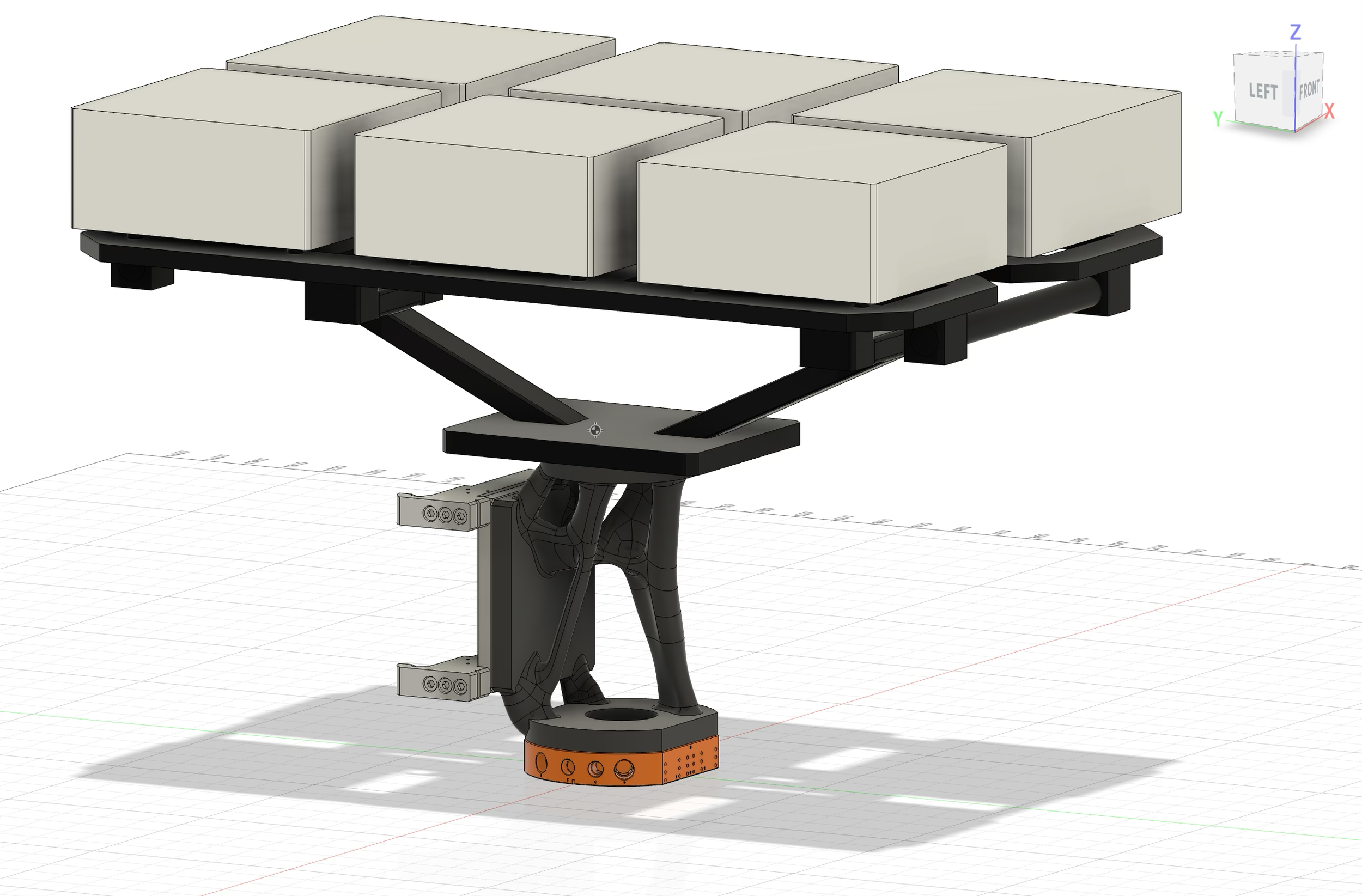
Subway Sentinel combines a rail platform, ABB IRB 6750S-215/3.9 robot, ATI QC-160 tool interface, and IDS Stream T GPR carrier in a digital concept intended to support repeatable tunnel and track-adjacent inspection.
Inspection-first architecture
The robot positions the GPR sensing face along selected tunnel and track-bed interfaces while the rail vehicle remains in motion. Future tool concepts may include LiDAR, thermal imaging, or low-light cameras.
Systems-level integration
The contribution is the integration of a full-size industrial robot, modular tool handling, commercial GPR geometry, rail-platform structure, and a transparent validation chain tailored to an NYC subway reference environment.
Preventive monitoring
During planned inspection windows, the moving platform follows a constrained scan cycle. Repeated GPR data could help trained teams identify indications consistent with voids, water-related changes, or other subsurface anomalies and compare conditions over time.
The current concept does not stop to scan. A July 9, 2026 review with a 12-year MTA conductor licensed to operate every train in the system established continuous vehicle motion as an operating requirement. Intended SafeMove-style speed, acceleration, reach, and clearance controls constrain robot motion; application-specific SafeMove validation remains future work.
A clear Yes/No framework keeps the MVP measurable.
The original evaluation framework is preserved below, with current status added so the brief reflects the project as it exists now.
A. Railcar Platform Innovation—Geometry & Interfaces Complete
- Rail Interface: Is the railcar modeled with steel rail wheels that seat on the rail head?
- Track Gauge: Is the wheel spacing designed to match the documented track-gauge assumption?
- Robot Mounting Plate: Is the robot mounting plate modeled with a defined bolt pattern matching the selected ABB robot base?
- Wheelbase and Mount Height: Are wheelbase length/width and robot mounting height defined for stability evaluation?
- Structural Continuity: Is the frame modeled as a continuous structure connecting the robot mount to the wheel/axle supports?
B. Loads, Strength, Stiffness & Stability Screening complete
- ABB Foundation Loads Identified: Are ABB foundation-load values captured for endurance and emergency-stop cases?
- Load Combination Assumptions Documented: Are conservative load assumptions documented?
- Foundation Requirements Considered: Are ABB foundation requirements acknowledged at an MVP level?
- Loads Applied Correctly: Are forces and moments applied at the mounting-plate location?
- Static Strength Check Completed: Has static structural analysis been completed using ABB foundation loads?
- Overbuilt Safety Margin: Does the design meet static Factor of Safety ≥ 3.0?
- Deflection Limit Met: Is predicted displacement at the robot mounting plate ≤ 1.0 mm?
- Anti-Tip Margin Verified: Does the railcar maintain a tip safety margin ≥ 1.5×?
- Low-CG / Ballast Strategy Defined: Is a low-center-of-gravity or resisting-mass strategy defined?
C. EOAT + GPR Mounting Complete
- EOAT Interface Defined: Is a custom EOAT modeled from the ABB wrist flange to the GPR mounting interface?
- EOAT Build Definition: Does the EOAT package include documented dimensions, mounting method, and fastener details?
- Payload Data Set for Simulation: Is the combined EOAT + GPR mass and center of gravity entered as RobotStudio load data?
All three criteria are complete. The final 70.2 kg payload, center of gravity, principal inertia, and axis-of-moment data are active in the RobotStudio tool definition.
D. Motion Study in RobotStudio Complete
- Reach and Configuration: Can the robot reach the defined tunnel inspection region without joint-limit violations?
- Singularity Management: Can the robot complete the inspection sweep without singularities, or are mitigations documented?
- Collision Avoidance: Does the motion avoid collisions with the tunnel envelope, railcar, and EOAT/GPR assembly?
- Tool Orientation Control: Is the EOAT/GPR kept at a defined orientation relative to the tunnel surface?
Motion Cycle 2 completed all four checks: 15 sidewall-to-crown targets, 75 mm standoff, controlled surface-normal orientation, and zero logged collision, singularity, or joint-limit events.
E. MVP Documentation Outputs Complete
- RobotStudio Proof Video: Is a short exported demo video included showing at least one inspection cycle?
- MVP Limits Declared: Are MVP limitations explicitly listed?
Both criteria are met. A full simulated inspection cycle is published on the engineering process page, MVP limitations are declared across the brief, and the final project showcase video was completed and submitted July 30, 2026.
Six objectives connect the brief to concrete engineering tasks.
The objectives below retain the original project deliverables while showing the current state of the work.
Objective 1: Establish Engineering Requirements and Design Assumptions Complete
- Document track gauge and tunnel clearance envelope. The system runs standard gauge, 1,435 mm, and the model uses that value. NYCT maintains two running-rail sections in parallel, 100-8 and 115RE, with 100-8 remaining the dominant installed section; 115RE was selected as the modern concept baseline.
- Define the inspection region and MVP simplifications.
- Set success metrics: FoS ≥ 3.0, mount-plate deflection ≤ 1.0 mm, anti-tip margin ≥ 1.5×, and no joint-limit violations.
Objective 2: Design a Structurally Credible Railcar Platform Complete
- Model wheelset and rail interface.
- Model railcar frame and robot mounting plate.
- Extract ABB foundation forces and moments from the selected robot manual.
Objective 3: Validate Structural Integrity and Stability Complete
- Run static structural analysis using ABB foundation loads.
- Record stress, displacement, and factor of safety.
- Complete anti-tip stability calculations and document sensitivity cases.
Objective 4: Design EOAT and Define Realistic Robot Load Data Complete
- Model the GPR form factor and EOAT adapter.
- Define mounting method, fasteners, mass, center of gravity, and inertia.
- Enter the final payload set into RobotStudio.
Objective 5: Demonstrate Motion Feasibility in RobotStudio Complete
- Build the RobotStudio station with tunnel, railcar, robot, EOAT, and GPR.
- Develop a continuous inspection sweep with controlled tool orientation and standoff.
- Check collisions, joint limits, singularities, and reach, then document the logged full-cycle result.
Objective 6: Deliver Clear MVP Evidence and Transparency Complete
- Document MVP limitations and maintain the assumptions and decision record.
- Assemble the final project showcase video.
The limitations, engineering record, and final showcase video are complete. The video was submitted July 30, 2026, closing Objective 6.
A digital prototype with defined evidence—and defined boundaries.
The MVP includes a modeled rail platform, ABB six-axis robot, custom wrist adapter, ATI QC-160 tool interface, GPR carrier, and tool-stand concept. The platform FEA, anti-tip checks, EOAT load definition, RobotStudio inspection cycle, and final project showcase video are complete at concept-screening or digital-simulation level.
Structural analysis uses ABB foundation loads and simplified static assumptions to evaluate frame stress, displacement, and factor of safety. The analysis supports a concept decision, but it does not certify welds, bolts, bogies, fatigue life, vibration behavior, controls, or field performance.
The current 2,778.7 mm platform exceeds the 2,679.7 mm A-Division reference by approximately 99.0 mm overall, or 49.5 mm per side. The deviation is caused by the scaled TR22 bogie proxy and remains a documented concept limitation; production design must use verified bogie geometry and return inside the controlling envelope.
Included in the SIPCAD integration, vendor-interface checks, mass properties, static platform FEA, anti-tip calculations, RobotStudio reach/collision/path studies, VR footage, and final documentation.
Outside the current MVPElectrical power design, PLC integration, live sensor feedback, real GPR signal processing, physical fabrication, dynamic vibration testing, fatigue qualification, and formal safety certification.
Required before deploymentMTA review, a production envelope corrected using verified bogie geometry, refined structural and joint analysis, tunnel testing, controls validation, formal risk assessment, and compliance with applicable rail and machinery standards.